
Hue
Hue Day Trip from Da Nang: Getting There, Tickets, Walking
Hue is about 100 km north of Da Nang and worth a long day if history is why you came. Here is how to get there, what the official Imperial City ticket costs, and how much walking to expect.

Yes, Hue works as a day trip from Da Nang — but it is a long one, and it is the add-on of central Vietnam rather than the headline. Plan on about twelve hours door to door: roughly two to two and a half hours each way by road through the Hai Van Tunnel, or two and a half to four hours by train, with three to four hours on foot at the Imperial City and one more site.
Go if the Nguyen dynasty and Vietnamese history are part of why you came. Skip it if you have three days or fewer and would rather spend them on Hoi An. The official Imperial City ticket is 200,000₫ for an adult (Hue Monuments Conservation Centre, checked 28 October 2026), and the whole site is walkable on flat ground with very few steps.
Our January 2026 filming covered Da Nang and Hoi An only. Mai Tiến Tần has not walked Hue for this guide, so we make no first-hand claims about it. Prices, hours and rules come from the Hue Monuments Conservation Centre’s official pages and travel times from published timetables, each dated; our own estimates are labelled.
Where Hue fits in a central Vietnam trip
Hue was the capital of Vietnam under the Nguyen emperors from 1802 to 1945, and its monuments were inscribed by UNESCO in 1993 as the Complex of Hue Monuments. It is a different kind of day from anything in Da Nang or Hoi An: formal, spread out and quiet.
The search data we have looked at tells a similar story: Hue draws much less interest than Da Nang and Hoi An, and we think that is roughly the right order for a first trip. If you have only three days in Da Nang and Hoi An, spend them there. With a fourth day to spare, Hue is a good use of it. With a longer trip, we would sooner sleep a night in Hue than rush it, which is how our two-week north-to-south plan treats it.
Getting there: road, train or driver
The distance is about 100 km. The time depends on what you choose.
Da Nang to Hue, the options
| Private car or driver, via the Hai Van Tunnel | about 2–2.5 hours |
| Train, Da Nang station to Hue station | 2h 28m – 3h 58m |
| Trains per day on that timetable | 11 |
| Rail distance | 103 km |
Source: vietnamtourism.com transport timetable, checked 21 October 2026. Road time is the figure given in the same page’s FAQ; traffic and stops change it. This is a private travel-information site, not a government one, so confirm train times with Vietnam Railways before you buy.
By road
A driver for the day is the simplest option and, for two or more people, usually the best one. You leave when you like, you stop where you like, and you are not tied to a train timetable on the way back. Agree the route, the waiting time and the price before you set off — the same rule we give in Da Nang to Hoi An.
By train
The line follows the coast, and scenery is the usual reason to choose it. It is slower than driving, so check the return train before you commit.
Gentle version
Go by car, not train, so that you control the start, the stops and the return. Ask for a driver who will wait through lunch rather than one who drops you at the gate.
The Hai Van Pass, and why you will probably miss it
The old road over the headland is about 21 km long and climbs to roughly 496 m. It is one of the best-known drives in Vietnam. Since the Hai Van Tunnel opened on 5 June 2005, almost all traffic goes underneath instead. The tunnel is 6,280 m long and, according to JICA, which financed it, it cut the crossing from over an hour to about ten minutes.
That is why a car heading to Hue will not necessarily take you over the pass. If you want the view, ask your driver for it specifically and expect to add time. One private-travel guide estimates the pass route adds about an hour on the Hue to Hoi An drive. On the pass stands Hai Van Quan, an old gate that the Hue conservation centre lists on its official price sheet at 70,000₫ for adults.

Tickets and opening hours
Official prices, adult
| Imperial City (Dai Noi) | 200,000₫ |
| Tombs of Minh Mang, Tu Duc or Khai Dinh, each | 150,000₫ |
| Imperial City + 2 tombs (3-site route) | 420,000₫ |
| Imperial City + 3 tombs (4-site route) | 530,000₫ |
| Children 7–12, Imperial City | 40,000₫ |
Source: Hue Monuments Conservation Centre, hueworldheritage.org.vn ticket page, single-site prices applied from 2 June 2026 and route prices from 4 January 2026; checked 28 October 2026. The list shows one adult price with no separate foreigner rate. Prices change without notice.
At the exchange rate we checked in early October 2026, the Imperial City ticket is a little under eight US dollars. The route tickets only save money if you really intend to visit the tombs, and a day trip rarely has time for more than one. The centre also sells e-tickets online.
Opening hours change with the season. From 16 October to 15 March, the season in force when we checked, tickets are sold from 07:00 to 17:00 and sites close at 18:00. From 16 March to 15 October, tickets run 06:30 to 17:30 and sites close at 18:30.
The Imperial City and how much you will walk
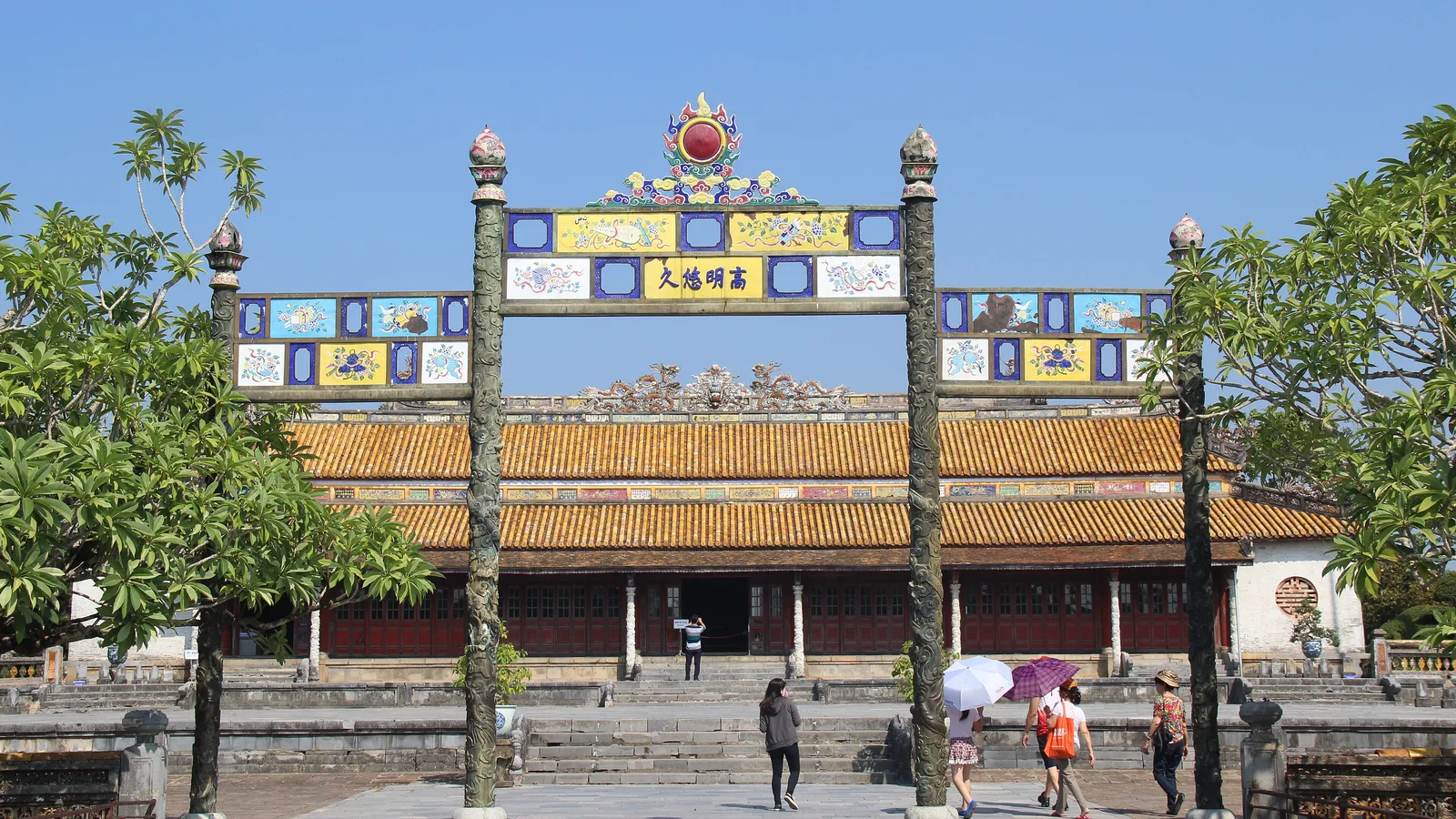
The Imperial City sits inside a much larger citadel, a roughly 2 km by 2 km walled enclosure. The palace compound at its heart is roughly square, with sides of about 600 m, according to the standard reference. It was heavily damaged in 1947 and again in 1968, during the Battle of Hue, so some halls are rebuilt and some areas are open ground where buildings once stood.
For a visitor over fifty, three things matter more than the distance:
- It is mostly flat. There are some steps at gates and halls, nothing like the staircases at the Marble Mountains.
- It is exposed. Courtyards are wide stone and brick, and shade is patchy. A hat and water matter more than good shoes.
- The route is long and loops. A full circuit of the main halls and courtyards is a few kilometres on foot. We have not measured it ourselves, so treat that as an estimate.
The official site lists an electric buggy service and an audio guide, which are the two obvious ways to shorten the day on foot. Ask at the gate for prices. The site rules ask for modest dress in the inner halls — no shorts, short skirts or sleeveless tops — and no hats inside, and they prohibit drones. For the wider picture of surfaces and stairs, read how much walking there really is on a Vietnam trip.
A day that works
- Leave Da Nang by 07:00. The road is quiet and you arrive before the tour buses.
- Imperial City from about 09:30. Give it two and a half to three hours. Do the main halls first and the outer areas only if you still feel like it.
- A long lunch, then sit down. Heat peaks after noon.
- One more site, not three. Either a single tomb or one pagoda by the river. The 4-site route ticket is for people staying the night.
- Head back by 15:30 or 16:00. You are in Da Nang or Hoi An for dinner and the day has not eaten the evening.
Hue is already a twelve-hour day. Adding Ba Na Hills or the Marble Mountains is how a good day turns into an exhausted one.
Weather and the time of year
Hue is wetter than Da Nang. Reference climate data puts the rainy season at September to December, with October the wettest month, so a courtyard-heavy site can be miserable. Our best time to visit guide covers the same coast. Carry a light rain jacket and read the forecast for Hue itself, not for Da Nang. Cash, cards and the banknote trap are covered in money in Vietnam, and packing in what to pack for central Vietnam.
Common questions
Can you do Hue as a day trip from Da Nang?
Yes, but it is a long day of roughly twelve hours including travel. Driving takes about two to two and a half hours each way through the Hai Van Tunnel, and trains take from about two and a half to four hours. Most visitors manage the Imperial City plus one other site.
How much is the Hue Imperial City ticket?
200,000₫ for an adult and 40,000₫ for a child aged 7 to 12, on the official Hue Monuments Conservation Centre ticket page checked on 28 October 2026. Route tickets that include tombs cost 420,000₫ for three sites and 530,000₫ for four.
How long do you need at the Imperial City?
Allow two and a half to three hours for the main halls and courtyards at an unhurried pace. This is our planning estimate rather than an official figure.
Is the Imperial City hard to walk?
It is mostly flat, with few steps, but it is large and exposed to sun. The effort comes from distance and heat rather than climbing. An electric buggy and an audio guide are listed on the official site.
Do you drive over the Hai Van Pass to reach Hue?
Usually not. Almost all road traffic uses the 6.28 km Hai Van Tunnel, which opened in 2005. If you want the old pass road for its views, ask your driver in advance, and expect it to add time.
Planning this trip yourself?
Ask us anything about the route, the pace or the timing. It goes straight to the office in Da Nang, not to a call centre — and if we are not the right company for your trip, we will tell you that too.






Mai Tiến Tần
Founder, Vietking Travel · Licensed international tour operator No. 01-1082/2018 · Company registered in Vietnam, 2011
Everything here is written from Da Nang, after walking the route. Prices carry the date they were checked. Where we do not have a figure we can stand behind, we say so rather than guess.