
Da Nang
Marble Mountains, Da Nang: the Stairs, the Lift and What You Actually See
Five limestone hills between Da Nang and Hoi An, with caves that have been shrines for centuries. There is one decision to make at the entrance, and it matters more than almost anyone tells you.

The Marble Mountains sit on the road between Da Nang and Hoi An, nearer the Da Nang end, close enough that most people see them as a forty-minute stop on the way somewhere else. That is a mistake, but not for the reason you would expect. The place is not large. It is vertical, and almost everything that matters about your visit is decided in the first two minutes, at the ticket window.
Five hills, named after the five elements. Only one of them, Thuy Son, the water mountain, is set up for visitors. Inside it are caves that have held shrines for centuries, a working pagoda, and a viewpoint over the coast that is one of the best in central Vietnam.
The decision at the entrance: stairs or lift
There are two ways up Thuy Son. A stone staircase, and a lift.
The staircase is the historic route and it is handsome — worn stone, shade, a gate at the top. It is also a long flight of uneven, polished stone, with a handrail on one side only in places. People photograph it and then start climbing it, and about a third of the way up a certain number of them regret it.
The lift is a glass box bolted to the side of the hill. It is not beautiful. It takes about thirty seconds and it costs less than a cup of coffee, and it puts you at the top of the hill with your legs intact for the part that actually matters, which is the walking inside.
Here is the thing nobody tells you: the lift does not remove the stairs. It removes the first set. The caves, the pagoda and the summit viewpoint all have their own steps, and those are the steep ones.
So the honest advice is not “take the lift because it is easier”. It is: take the lift up, keep the climbing in your legs for the caves, and walk down the staircase at the end when you have already seen everything and nothing is riding on it. Going down worn stone is easier than going up it, and if your knees dislike descending, the lift runs both ways.

What it costs
Prices at the Marble Mountains
| Entry to Thuy Son | 40,000₫ |
| Lift, one way | 15,000₫ |
| Lift, both ways | 30,000₫ |
Source: Da Nang city tourism portal, checked 27 October 2026. Prices can change without notice; the board at the ticket window is the authority on the day.
At the exchange rate we checked in early October 2026, entry plus the lift one way is somewhere around two US dollars. It is one of the cheapest major sights in the country, which is worth knowing because it changes how you should think about the visit: there is no financial reason to rush it, and no financial pain in taking the lift.
If you are travelling with cash and wondering what else to carry, we wrote about that separately in money in Vietnam.
What is actually inside
Three things, in rough order of how much they surprise people.
The caves
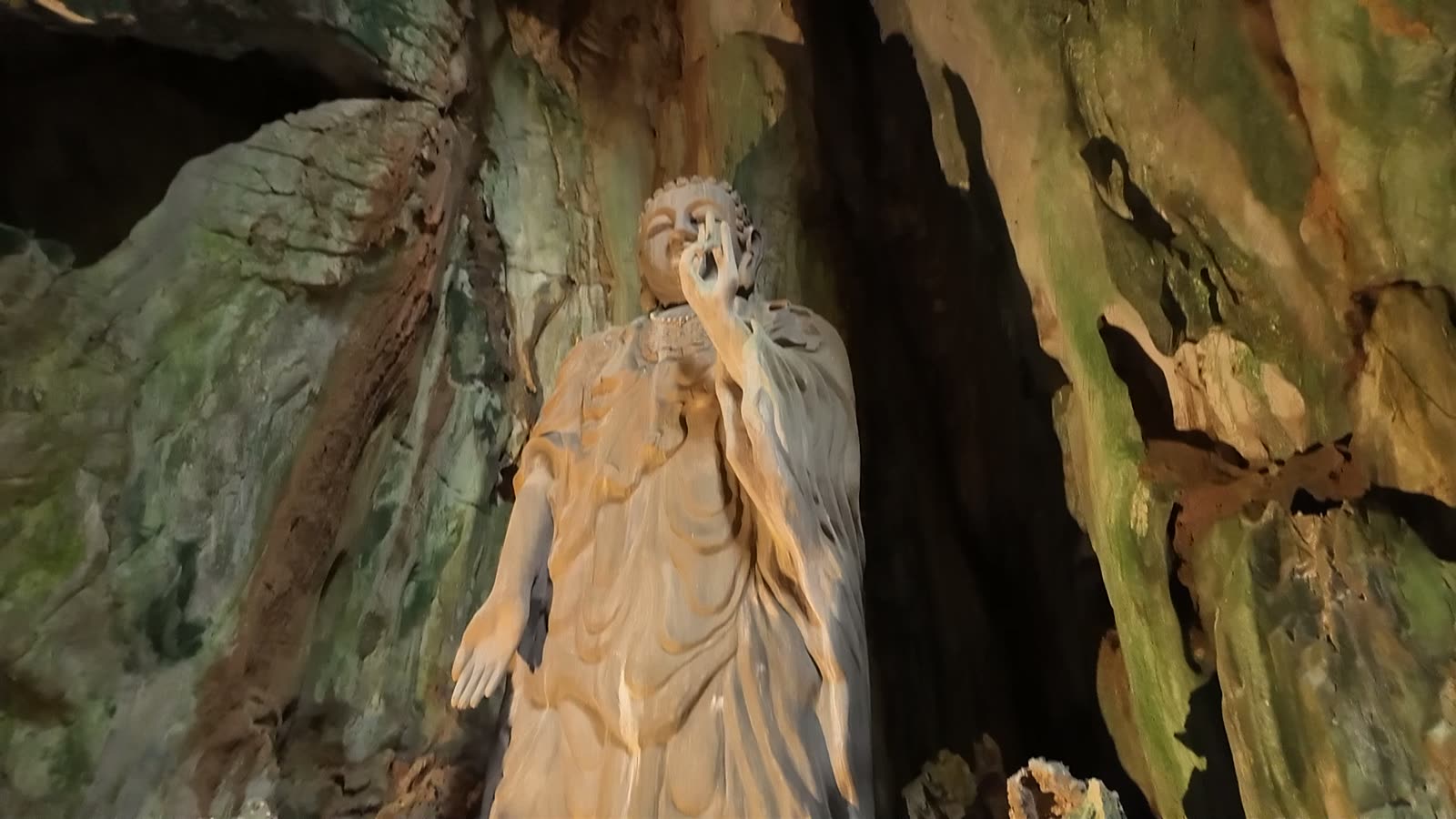
The big one, Huyen Khong, is a natural chamber open at the top, so shafts of daylight come down through the rock onto a Buddha figure set against the far wall. There is incense smoke in the light. It is genuinely one of the more affecting interiors in Vietnam, and photographs of it almost never do it justice because the contrast between the dark and the light beams is beyond what a phone camera handles.
The smaller caves — Tang Chon among them — are quieter, lower and more intimate, with figures carved directly into the rock and shrines tucked into alcoves. Some of them require stooping. Some have a step down in the dark that your eyes need a moment to find.
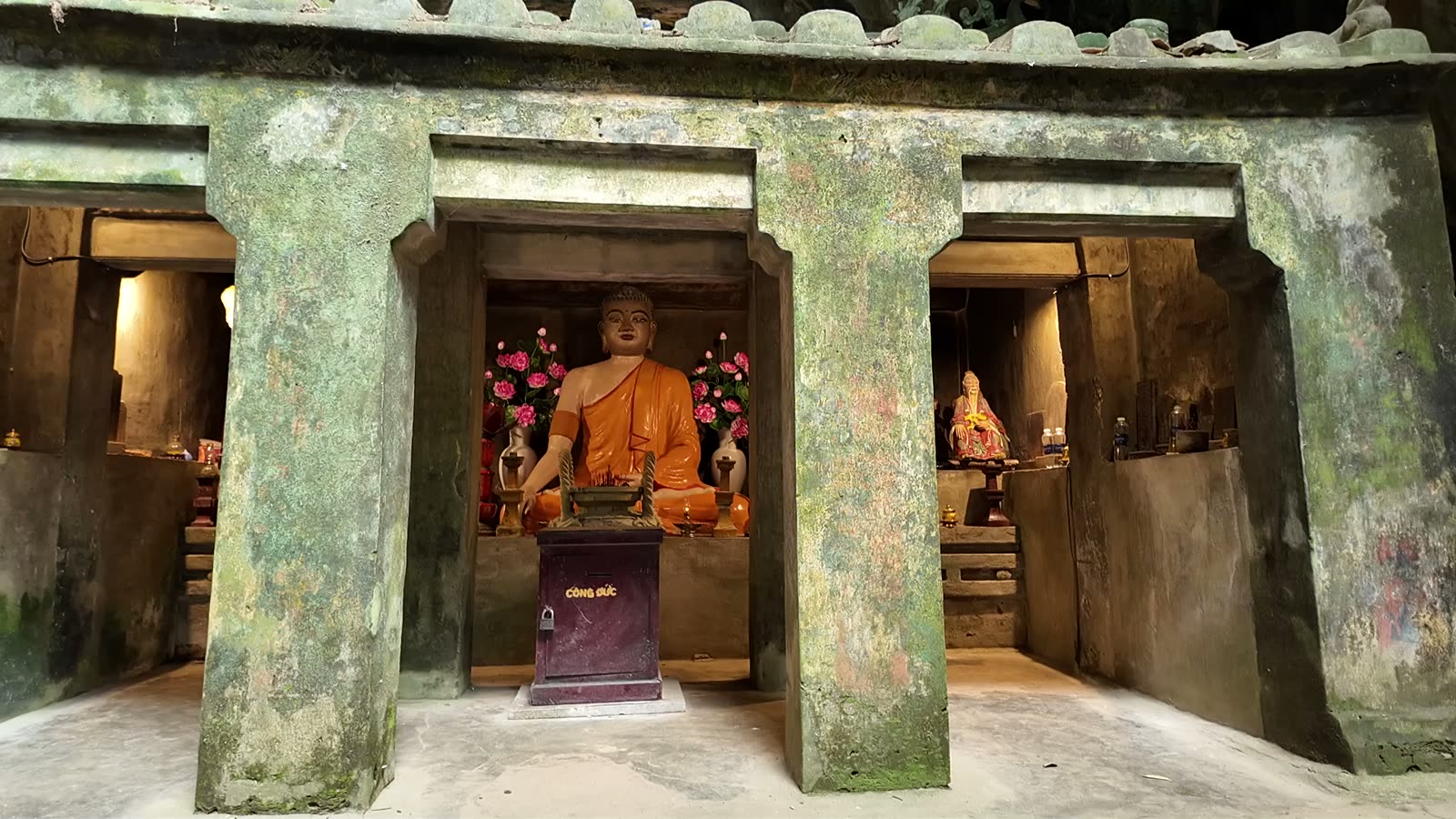
Tam Thai Pagoda
An active pagoda, not a museum piece. People come here to pray. Dress as you would for any place of worship — shoulders and knees covered — and keep your voice down inside the halls. Nobody will stop you if you do not, which is exactly why it is worth doing.
The summit viewpoint
The highest point on Thuy Son looks out over the coast, the other four marble hills rising out of flat ground, and Da Nang in the distance. On a clear day you can see the length of the beach. Getting there involves the steepest, narrowest stairs on the hill — a proper scramble in two places, with a chain rather than a handrail.
The final climb to the summit is the one part of the Marble Mountains we would not describe as suitable for everyone. If stairs are an issue for you, the caves and the pagoda are the heart of the place and both are reachable without it. You are not missing the point by skipping the top.
What the ground is like
This matters more than the step count, and it is the part that brochures never mention.
The paths on Thuy Son are cut marble and old stone. Generations of feet have polished them. In the caves, water seeps through the rock all year, so the floors are often damp even in the dry season, and polished wet stone is slippery in a way that dry stone is not. We have watched more than one person in smooth-soled shoes take a short, undignified slide.
- Shoes with a grip pattern. Not sandals, not new leather soles.
- One free hand at all times — the handrails are inconsistent and you will want to reach for rock.
- A small torch or your phone light for the darker cave corners. Your eyes adjust slowly coming in from tropical daylight.
- Water. There is shade but no breeze inside the hill, and it is humid.
If the question of stairs and surfaces is the thing that decides whether you enjoy a trip, we have written a longer piece on exactly that: how much walking is there really on a Vietnam trip.
How long to allow, and when to go
Most tours allow an hour. An hour is enough to walk through and leave. Ninety minutes to two hours is enough to sit in Huyen Khong cave for ten minutes, go up to the viewpoint, and come down the staircase without hurrying.
Go early. The hill faces the sun, there is little shade on the open paths between caves, and by the middle of the day in the warm months the stone radiates heat. First thing in the morning the caves are also quieter, and quiet is most of what makes them work.
This fits naturally as the first stop of a day that ends in Hoi An — which is how we lay it out in our three-day plan for Da Nang and Hoi An. Getting from one to the other is covered in Da Nang to Hoi An.
The stone-carving village at the bottom
At the foot of the hill is Non Nuoc, a village that has carved stone here for generations. The workshops run along the road and the yards are full of figures, some of them three metres tall.
Two honest notes. First, it is a genuine working craft, and watching someone shape stone with a chisel for five minutes is more interesting than most things you will pay for that day. Second, the marble is no longer quarried from the mountains themselves — that was stopped to protect them — and some of what is sold is not local stone at all. If you are buying something small, buy it because you like it, not because of where you assume it came from.
Drivers are sometimes paid a commission to bring visitors into a particular workshop. There is nothing sinister about this and the stone is often good. But you are under no obligation to buy, a polite no is completely normal, and you are free to walk two doors down.
Common questions
How many steps are there at the Marble Mountains?
We are not going to print a number we have not counted. Different guides quote different totals and we have not counted them ourselves. What is true is that the main staircase from the entrance is one long flight, and there are several further flights inside the hill, including a steep final climb to the summit. If a precise figure matters to you, plan instead around the fact that the lift removes only the first staircase and the rest cannot be avoided.
Is there a lift at the Marble Mountains?
Yes. A glass lift runs up the side of Thuy Son, costing 15,000₫ each way as checked on 27 October 2026. It is separate from the 40,000₫ entry ticket and you can buy it one way.
How long do you need at the Marble Mountains?
Ninety minutes to two hours to see the caves, the pagoda and the viewpoint without hurrying. An hour is enough only to walk through.
Can you visit the Marble Mountains with limited mobility?
Partly. The lift removes the main staircase, and the pagoda and the larger caves are reachable from the top with moderate walking on uneven stone. The summit viewpoint and the smaller caves involve steep, narrow steps and are not suitable for everyone. There is no step-free route through the hill.
What should I wear to the Marble Mountains?
Shoes with grip, because the cave floors are damp and the stone is polished, and clothing that covers shoulders and knees, because Tam Thai Pagoda is an active place of worship.
Are the Marble Mountains worth visiting?
Yes, and particularly the cave interiors, which are the part people remember. If you only have one short stop between Da Nang and Hoi An, this is the one we would choose.
Planning this trip yourself?
Ask us anything about the route, the pace or the timing. It goes straight to the office in Da Nang, not to a call centre — and if we are not the right company for your trip, we will tell you that too.



Mai Tiến Tần
Founder, Vietking Travel · Licensed international tour operator No. 01-1082/2018 · Company registered in Vietnam, 2011
Everything here is written from Da Nang, after walking the route. Prices carry the date they were checked. Where we do not have a figure we can stand behind, we say so rather than guess.