
Planning
The Best Time to Visit Da Nang and Hoi An
Guides disagree about where the seasons begin and end, which tells you something useful in itself. Here is what the measured data says, what it does not say, and how we would choose a month.

Ask five travel sites when the dry season starts in Da Nang and you will get five answers. One says February. One says April. One says January. They are all written with total confidence.
That disagreement is not a failure of research. It is the honest shape of the thing: central Vietnam does not have a clean switch between seasons, it has a gradient, and where you draw the line depends on what you are willing to put up with. So rather than add a sixth confident answer, here is what the measured data actually shows, what it does not, and how we would pick a month.
What the measured data shows
Set aside the season labels and look at one number: how many days in a month it actually rains.
Wet days per month, Da Nang
| October — the wettest month | about 18 days |
| February — the driest month | about 2 days |
Source: WeatherSpark long-term climate summary for Da Nang, counting days with at least 0.04 in of precipitation. Checked 28 October 2026. These are long-run averages, not a forecast for your dates.
That is the whole argument in two lines. In October, rain is the normal condition — more than half the days. In February, it is an event. Every other month sits somewhere on the slope between them, and the slope is steeper in the second half of the year.
Where the guides disagree is where to draw the line on that slope. Where they agree is October and November. Nobody recommends them.
The short answer
February to May. If you can travel then, travel then. Low rainfall, temperatures that have not yet reached the summer peak, clear skies for the viewpoints, and the sea calm enough to be worth getting into by the later part of that window.
Avoid October and November unless you have a specific reason. That is when the rain concentrates, when the typhoon risk is highest, and when Hoi An’s old town floods.
Everything else is a trade-off rather than a mistake.
Month by month, with the trade-offs
February, March, April, May — the reliable window
The least rain of the year and the most dependable skies. April and May are warmer than February and March and the sea is better. If you want the Golden Bridge with a view behind it rather than cloud, this is when to plan for it.
The only real drawback: this is also when everyone else who did their research arrives.
June, July, August — hot, and that is the whole story
Rain is still low. The issue is heat and humidity, which changes what a day of sightseeing feels like far more than most people expect. Stone radiates it, caves hold it, and standing in it is harder than walking in it.
Perfectly workable if you restructure the day: everything outdoors before eleven, nothing at all between one and four, and the evenings for the old town. That is how we build the three-day plan anyway, and in summer it stops being a preference and becomes a requirement.
September — the turn
Rain begins to build and typhoon season starts. Still often fine, but the risk profile changes and travel insurance starts to matter in a way it did not in April.
October and November — the months to avoid
The wettest period of the year, the peak of the typhoon season, and the time when Hoi An floods. See below.
December and January — better than their reputation
Rain is tailing off and crowds are lower than in spring. It is cooler — pleasant for walking, less so for swimming — and skies are more variable, with grey mornings that clear.
This is a genuinely good window for anyone whose main interest is the towns, the food and the history rather than the beach. It is also when we did our own filming, and the section below says exactly what we got.
The flooding, which deserves its own section
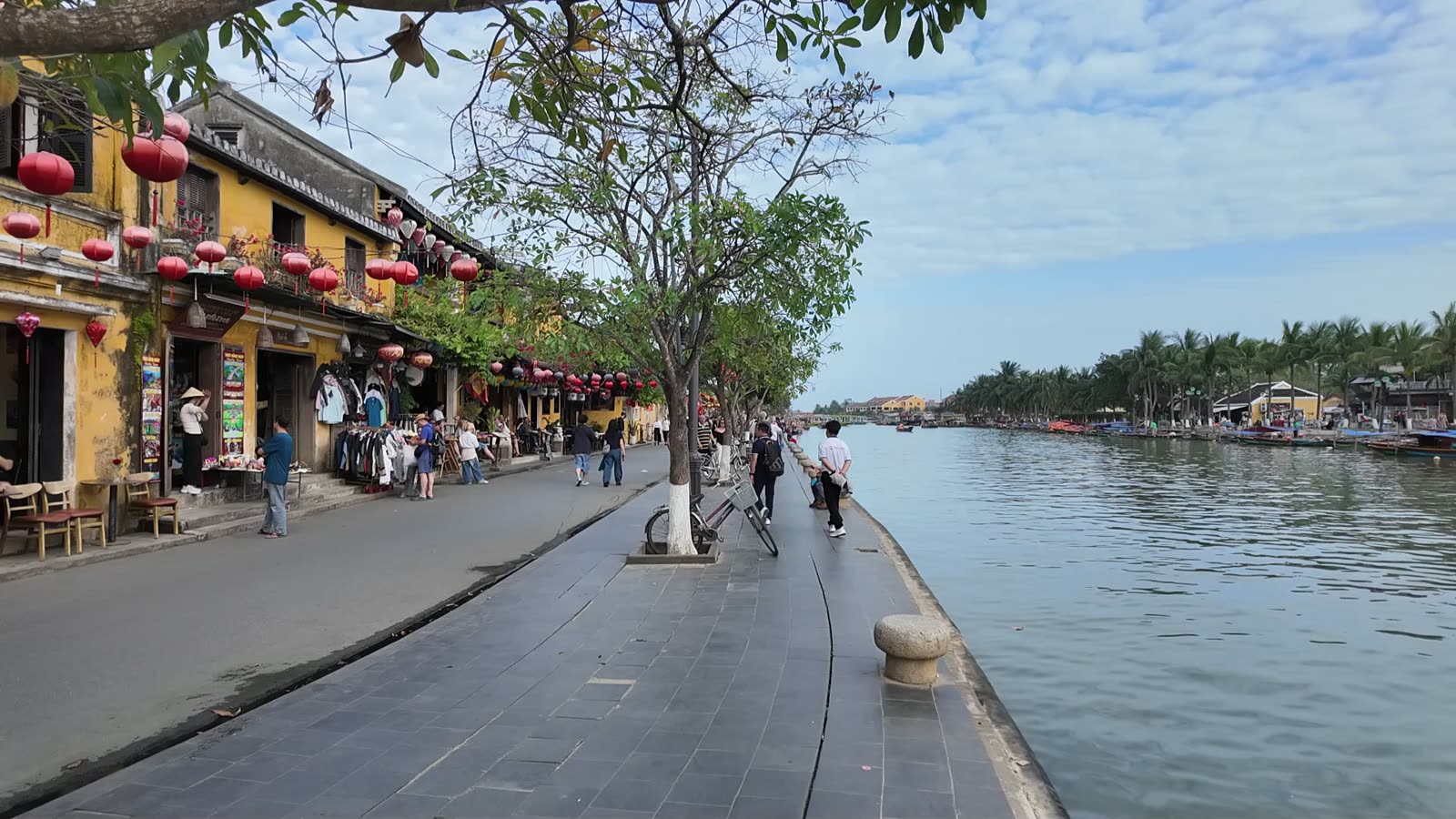
Hoi An’s old town sits on the Thu Bon river, barely above it. In the autumn the river rises and the streets nearest the water go under. This is not rare and it is not a disaster — it is an annual feature of life there, and the families in the old houses mark the heights on their own walls, which you can see on the heritage house visits.
What it means practically:
- Some riverside streets and some heritage sites close for days at a time.
- Boats move through streets. Visitors photograph this; residents are moving their furniture upstairs.
- Roads between Da Nang and Hoi An can be affected, which is a problem if you have a flight.
- Central Vietnam saw severe flooding in the autumn of 2025, which is worth knowing as context rather than as a forecast.
Build slack into the end of the trip rather than the start, keep at least a full day between your last excursion and your flight, and take insurance that actually covers weather disruption rather than assuming it does. We would also book accommodation away from the river.
The mountain is a separate climate
One thing no monthly table captures: Ba Na Hills has its own weather, and it is not Da Nang’s. The city can be in full sun while cloud sits on the summit, in any month.
So “I booked a dry month” does not protect the Golden Bridge view. The only thing that protects it is keeping that day movable. We explain how that played out for us in Ba Na Hills in the rain.

What January was actually like
Two dated observations, since general advice is easy and specifics are not.
- 22 January 2026. Clear and bright all day. The Marble Mountains in the late morning, the coconut forest in the afternoon, Hoi An old town from half past three and the lanterns from about six. Blue sky throughout. A better day than the month’s reputation would suggest.
- 24 January 2026. Cloud sat on Ba Na from early morning until a quarter past one, when it cleared completely. By half past two we were back beside the Han River in Da Nang under an entirely blue sky. The city had been fine the whole time.
Two days, both in the supposedly uncertain part of the year, and the only real problem was altitude rather than season.
Common questions
What is the best month to visit Da Nang and Hoi An?
February to May is the most reliable window, with the least rain and the most dependable skies. February has the fewest wet days of the year, averaging about two.
What is the rainy season in Da Nang?
Published guides disagree on the exact boundaries — some say September to January, others September to March, others August to December. What they agree on is the peak: October and November are the wettest, with October averaging about eighteen wet days.
Does Hoi An flood?
Yes, most years, in the autumn. The old town sits just above the Thu Bon river and the streets nearest the water go under, sometimes for several days. Some heritage sites close while it lasts.
Is January a good time to visit Da Nang?
Better than its reputation. Rain is tailing off, crowds are lower than in spring, and it is cool enough to walk comfortably. It is not beach weather, and skies are more variable than in March or April.
When is typhoon season in central Vietnam?
Risk is concentrated in the autumn, with September to November generally described as the peak. If you travel then, leave slack in the itinerary before your flight home and check that your insurance covers weather disruption.
Will good weather in Da Nang mean good weather at Ba Na Hills?
No. The summit is well over a kilometre above the city and makes its own weather, so cloud can sit on the mountain while Da Nang is in full sun. Keep that day flexible in any month.
Planning this trip yourself?
Ask us anything about the route, the pace or the timing. It goes straight to the office in Da Nang, not to a call centre — and if we are not the right company for your trip, we will tell you that too.



Mai Tiến Tần
Founder, Vietking Travel · Licensed international tour operator No. 01-1082/2018 · Company registered in Vietnam, 2011
Everything here is written from Da Nang, after walking the route. Prices carry the date they were checked. Where we do not have a figure we can stand behind, we say so rather than guess.