
Hoi An
The Assembly Halls of Hoi An: Which One to Spend Your Ticket On
Hoi An’s Chinese merchant communities left five assembly halls in the old town. Most visitors have time for one or two, and not every hall is confirmed on the ticket. Here is which ones are, how to choose, and what we could not confirm.
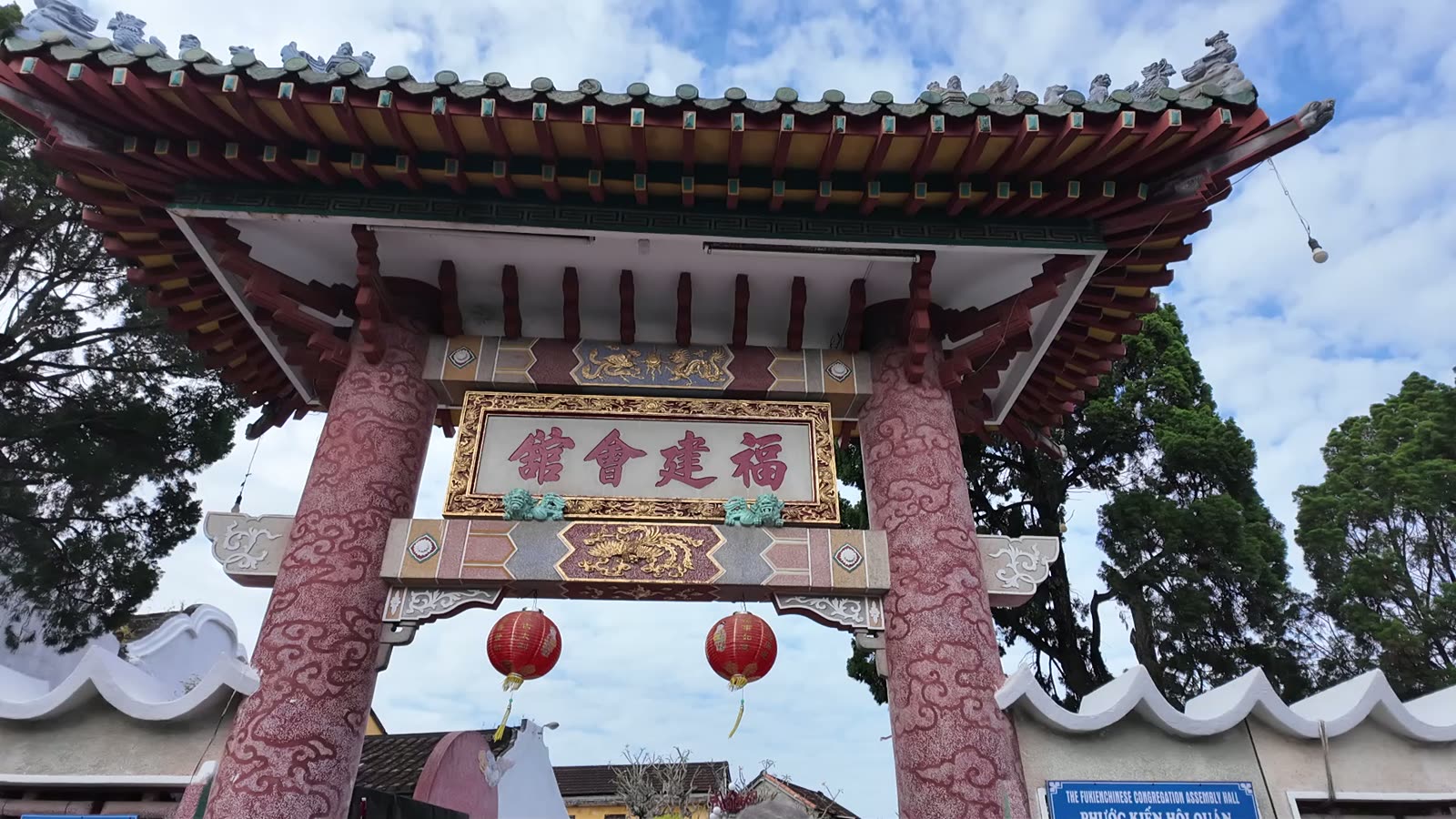
Walk the main street of Hoi An’s old town and every few minutes you pass a gate that looks nothing like the yellow shophouses around it: red columns, green-glazed tiles, gold characters, a courtyard behind. These are the assembly halls, built by the Chinese merchant communities who settled in the port, and they are the most elaborate interiors in the town.
Most visitors have time for one, perhaps two. This page tells you which halls there are, which ones we can confirm are on the old town ticket, and how to choose. Where we could not confirm something, we say so.
What an assembly hall is
Merchants who came to Hoi An from the same part of China built a hall together. It did three jobs at once. It was a meeting place where the community settled its business, a temple to the gods that protected its trade and its sea voyages, and a kind of embassy for newcomers from home. The Vietnamese name is hoi quan.
That is why each hall is dedicated to someone different. The heritage centre’s own site says the Fujian hall honours Thien Hau, the sea goddess sailors prayed to, and the Cantonese hall honours Quan Cong, the deified general also known in China as Guan Yu. When you step inside, the altar at the back tells you who the community trusted to keep them alive at sea.
These are still places of worship. Incense coils hang from the ceilings, people come to pray, and the doorways have high wooden sills you step over rather than on. Dress as you would for a temple and you will be fine.
The five halls, and which ones the ticket covers
The official Hoi An heritage site names five Chinese assembly halls in the old town. What we could not find is a single current official list that says which of them take a coupon from the old town ticket. Here is what each source actually says.
The five assembly halls
| Fujian (Phuc Kien) | On the ticket |
| Cantonese (Quang Dong) | On the 2012 ticket list |
| Chaozhou (Trieu Chau) | On the 2012 ticket list |
| Hainan (Hai Nam) | Opened to visitors, Nov 2016 |
| Ngu Bang, also called the Chinese (Trung Hoa) hall | Not confirmed |
Sources: Hoi An heritage centre site, article of 4 April 2025 (names the five halls); Hoi An heritage centre ticket page, dated 1 May 2012 (lists Fujian, Cantonese and Chaozhou among the ticketed sites; it is old, and its prices and rules have since changed); Da Nang city tourism portal, Fujian Assembly Hall page (says the Fujian hall is included in the old town ticket); VietnamPlus, 23 November 2016 (Hainan hall added to the old town visitor route). All checked 12 November 2026. The heritage board’s January 2026 ticket notice does not name individual halls, so ask at the booth.
So, plainly: the Fujian hall is on the ticket. The Cantonese and Chaozhou halls appeared on the heritage centre’s own list of ticketed sites, and we have no reason to think they have come off it, but that list is from 2012. For the Hainan and Ngu Bang halls we found no official statement either way, so we do not tell you whether they take a coupon. The booth will.
How many sites your ticket covers depends on which of the two price levels you buy, and published sources describe that differently. Rather than add another version, we keep that question on one page: the Hoi An old town ticket explained.
The Fujian hall: the numbers, with sources
It is the one hall we can give you hard figures for, partly because the city publishes them and partly because the sign at its gate does. We filmed that sign on 22 January 2026, walking the old town for our own video.
Fujian Assembly Hall (Phuc Kien Hoi Quan)
| Address, from the sign at the gate | 46 Tran Phu |
| Classified as a national relic, per the sign | 19 March 1985 |
| Opening hours on the gate sign | 07:00 – 18:00 |
| Opening hours, city tourism portal (“typically”) | 07:00 – 17:00 |
| Assembly hall built on the site, per the portal | 1697 |
| Rebuilt and expanded, per the portal | 1757 |
| Old town ticket, two price levels | 80,000₫ · 120,000₫ |
Sources: the blue sign at the gate of the hall, filmed by us on 22 January 2026; Da Nang city tourism portal, Fujian Assembly Hall (page dated 8 December 2025); Hoi An heritage management board notice of 29 January 2026 (ticket levels). All checked 12 November 2026. The two opening times disagree, so plan to be inside before 17:00. Prices and hours change without notice.
The heritage centre’s site calls it the largest of the Chinese halls in Hoi An. It is also the easiest to find, on the main street a short walk from the market, and the one with the most to look at: a gate, a long courtyard, side halls and the main sanctuary at the back.
Which one to spend your ticket on
This part is our judgement, not a measurement. It comes from walking the old town and from what each hall is for.
- If you go into only one, make it Fujian. It is the largest, it is certainly on the ticket, and it is open from the morning. If you see one interior in Hoi An, this gives you the most for one coupon.
- If you have room for a second, choose the Cantonese hall for a contrast. It is also on Tran Phu, the main street, so it costs you almost no extra walking. It honours a different god and was built in a different regional style, so the two do not blur together the way two merchant houses can.
- Choose Chaozhou instead if you dislike crowds. It sits on Nguyen Duy Hieu street, off the main run of Tran Phu, and is usually quieter for that reason. Its carved woodwork is the thing people go for. We have not filmed inside it, so we will not describe it beyond that.
- Treat Hainan and Ngu Bang as walk-past halls unless the booth tells you otherwise. The 2016 report puts the Hainan hall on Tran Phu too, so you will probably pass it anyway. From the street you can see a gate and part of a courtyard, and that may be enough. Ask at the booth whether they use a coupon before you plan around them.
The Hainan hall keeps tablets to 108 people who were given an honorary title by Emperor Tu Duc, according to the 2016 VietnamPlus report on its opening. The story usually told in Hoi An is that they were Hainanese traders wrongly put to death and later cleared. The report we checked does not tell it that way, so take it as the town’s story rather than a documented fact.
What we would not do: spend three coupons on three assembly halls. They share a plan, a gate, a courtyard and an altar, and by the third they start to look alike. One hall, one old merchant house and one museum make a better afternoon than three of the same thing.
How to visit without wasting the afternoon
- Go in the late afternoon, before about five. The heat has eased by four, the light in the courtyards is softer, and you are still inside the opening hours. The full shape of a Hoi An day is in our Hoi An travel guide.
- Keep your ticket in your hand, not your bag. Staff at the gate take or mark a coupon each time.
- Watch the door sills. They are high, and they are there on purpose. Step over, not on. If uneven steps are a concern, how much walking there really is covers the old town surfaces honestly.
- Allow twenty to thirty minutes for each hall. That is our estimate of an unhurried look, not an official figure. The Fujian hall deserves the longer end of it.
- Then go to the river. The halls close as the lanterns come on, which is exactly when the second half of the day begins: Hoi An at night.
If you are still working out how many nights to give Hoi An at all, our three days in Da Nang and Hoi An shows where an afternoon of halls and houses fits.
Common questions
How many assembly halls are there in Hoi An?
The official Hoi An heritage site names five Chinese assembly halls in the old town: Fujian, Cantonese, Ngu Bang (also called the Chinese hall), Chaozhou and Hainan. Checked 12 November 2026.
Which Hoi An assembly hall is the best to visit?
If you only see one, the Fujian Assembly Hall. The heritage centre describes it as the largest, the city tourism portal confirms it is on the old town ticket, and it is on the main street near the market. Add the Cantonese hall for contrast, or the Chaozhou hall if you prefer somewhere quieter.
Is the Fujian Assembly Hall included in the Hoi An ticket?
Yes. The Da Nang city tourism portal says it is included in the Hoi An Ancient Town ticket, checked 12 November 2026. Each visit uses one coupon from the ticket.
Are all the assembly halls on the old town ticket?
Not confirmed. The heritage centre’s ticket page, dated 2012, lists Fujian, Cantonese and Chaozhou. We found no official statement on Hainan or Ngu Bang, and the January 2026 ticket notice names no halls. Ask at the ticket booth which halls your ticket covers.
What time does the Fujian Assembly Hall open?
The sign at its gate, filmed on 22 January 2026, gives 07:00 to 18:00. The Da Nang city tourism portal says it is typically open 07:00 to 17:00. Plan to be inside before 17:00 to be safe.
What should I wear to visit an assembly hall in Hoi An?
The halls are still places of worship, so dress as you would for a temple, with shoulders and knees covered. Step over the high wooden door sills rather than on them.
Planning this trip yourself?
Ask us anything about the route, the pace or the timing. It goes straight to the office in Da Nang, not to a call centre — and if we are not the right company for your trip, we will tell you that too.


Mai Tiến Tần
Founder, Vietking Travel · Licensed international tour operator No. 01-1082/2018 · Company registered in Vietnam, 2011
Everything here is written from Da Nang, after walking the route. Prices carry the date they were checked. Where we do not have a figure we can stand behind, we say so rather than guess.